This manuscript shows that many college students experience food insecurity even when they have meal plans, largely due to limited food options, time constraints, financial pressures, and dining hours that don’t match their schedules. Authors include GW's Gabby Headrick.
Research
Research We're Doing
From One City to Many: Scaling Best Practices for Healthy Corner Stores
Principal Investigator: William Dietz, MD, PhD
Co-Investigator: Uriyoán Colón-Ramos, ScD, MPA
Collaborators: Daniel Chen, DrPH; Caitlin Grady, PhD
This GFI-led research project, funded by the Patrick J. McGovern Foundation, collaborates with DC Central Kitchen (DCCK) and Partnership for a Healthier America to evaluate DCCK’s Healthy Corners program, a leading national model to advance healthier food choices in urban corner stores.
GFI-Supported Research
GFI supports and conducts research that examines the food system from global, domestic, and local perspectives. The following projects are funded by the institute’s pilot grant program and led by GFI affiliate faculty and staff or are led by GFI directly.
Data-Driven Insights to Address Food Insecurity Among College Students
Principal Investigator: Gabby Headrick, PhD, MSPH, RDN
Co-Investigator: Jennifer Sacheck, PhD
Other members of the research team: Andrew Sonn, Ed.D
Preventing Postharvest Loss Through Solar-Powered Cold Storage Innovation
Research Team: Moses Mosonsieyiri Kansanga, PhD MPhil; Robert Orttung, PhD MA; and David Rain, PhD
Principal Investigator: Allison Sylvetsky, PhD
Co-Investigators: William (Doug) Evans, PhD; Jennifer Sacheck PhD; and Nia Bodrick MD
Consultant: James Krieger, MD MPH (University of Washington)
Assessing Impacts of Private Investments in Transforming Smallholder Farming
Principal Investigator: Samuel Ledermann, PhD
Co-PI: Michael Mann, PhD MA
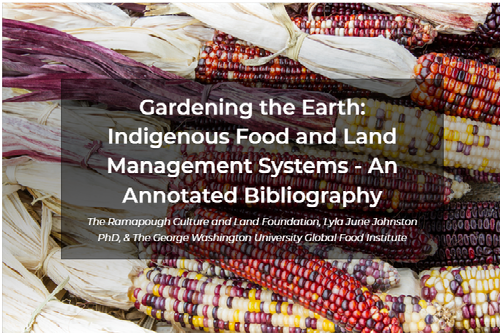
Gardening the Earth: Indigenous Food and Land Management Systems - An Annotated Bibliography
In partnership with Lyla June Johnston and the Ramapough Culture and Land Foundation, GFI’s Tara Scully helped launch the Indigenous Website Annotated Bibliography—a collaborative space dedicated to uplifting Indigenous voices, preserving cultural wisdom, and advancing food sovereignty initiatives. Got references to share? Use our submission form to add your suggestions and help grow this collaborative platform
GFI Food System Collaborative
Dive into this interdisciplinary seminar series where GW faculty and staff apply systems thinking and modeling to tackle complex challenges in food and agriculture. Building Systems Dynamic Connections (BSDC) fosters collaboration, sparks new ideas, and provides a platform to share innovative research and approaches across the university community.
GFI Awards Prizes for 2025 GWSPH Research Day
Congratulations to the Milken Institute School of Public Health's students and staff who were recognized with Global Food Institute prizes for their outstanding research at the GWSPH Research Day 2025!
GW Food and Agriculture
Related Research
Surveying the Food Aid Ecosystem: Six Months Post-USAID
A new study from the George Washington University finds that the humanitarian aid system is undergoing fundamental changes following the U.S. Agency for International Development’s withdrawal from key global operations.
Stakeholders in Puerto Rico attributed high sugar‑sweetened beverage consumption to widespread distrust in water safety. They identified strengthening water infrastructure, improving real‑time water quality transparency, and counter‑marketing SSBs as key leverage points, emphasizing that water insecurity must be addressed. Authors include GW's Uriyoán Colón‑Ramos, Daniel Chen, and Wendy Ellis.
Deliberate Actions to Weaken the Federal Nutrition Safety Net
This article shares the critical role of federal nutrition programs. The article underscores how the administration and Congress are pursuing policies and actions that, taken as a whole, will weaken management, oversight, and funding of FNS programs and their positive impacts on nutrition. Authors: GFI's Stacy Dean and Harvard's Sara Bleich.
GW’s Nurturing Opportunity and Understanding Resources to Improve Student Hunger (NOURISH) study
This study found that more than one‑third of students experienced food insecurity during Fall 2024 and that those facing food insecurity reported significantly poorer physical health, high stress, and limited use of available campus food resources. The report concludes that stronger outreach, better‑coordinated support, and evidence‑based interventions are needed to meet students’ unmet food needs.
This report, co-authored by GFI Faculty Gabby Headrick, shares current food inequities and potential benefits of urban agriculture.
How School Meals Can Help Change the Climate
This article highlights the broad benefits of universal school meals and emphasizes a lesser-known but powerful opportunity: using school food procurement policies to improve both public health and climate outcomes. Authors: William H. Dietz and Sydney Pryor.
Study explores Ghanaian farmers' willingness to adopt solar-powered cold storage, analyzing economic, perceptual, and contextual adoption factors. Authors: Moses Kansanga, Lalitha Shanmugasundaram, Samuel Ledermann, David Rain.
A collaborative report from the Global Food Institute and James Beard Foundation on the immediate threats that climate change poses to independent restaurants, their employees, and the farmers who supply them.
Mitigation of the U.S. agrifood sector’s contribution to human and planetary health: a case study
Authored by William H. Dietz, MD, PhD and Jessica Fanzo